Emergencies:
911

Non Emergencies:
Sheriff's Office
915-546-2280
e-mail us

El Paso Police
915-832-4400

Click here for Department of Homeland Security

  • Special Reaction Team
  • The Sheriff's Department Special Reaction Team was established in 1987, under authority of the Sheriff to meet specific needs of the Detention Division, which may arise during the course of operations.
  • The S.R.T. was established to deal with emergency or extraordinary situations. Any supervisor is authorized to request the team to deal with a situation whenever it is determined that on scene resources are unable to bring it to a safe, successful resolution
  • In 1997, SRT was created / established at the Jail Annex. That Consisted of the same number of team members and chain of command. However, SRT had to modified its training due to the construction of the Facility.
  •  
  • Who is SRT?
  • The Special Reaction Team is a pool of highly trained personnel to be used to cope with particularly crucial or chaotic situations. The S.R.T. is established within the facility in order to perform tasks that may be beyond the scope of detention officer's duties. The SRT has intrusion, extraction and rescue capabilities. Due to the conditions that may result in the team being called out, the S.R.T. members answer only to their Commanders and the facility's directors.
  • THE S.R.T.'S GOAL IS: To insure the success of any related situation and to culminate it in the safest way possible.
  •  
  • The operations and capabilities of the S.R.T.
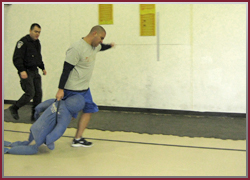
  • Once a security plan is employed, the team can perform take downs, restraints, captures and extractions on inmates who are exhibiting a disruptive behavior.
  • The S.R.T. can be utilized to insure the security of the facility (ie.: performing shakedowns, security perimeter watches, security during evacuations, and prisoner escort (both local and traveling), when instructed to do so.
  • The team may participate in fire fighting, use of special equipment for rescues and extractions.
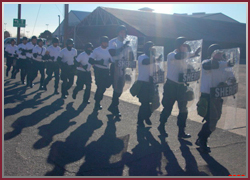
  • • The S.R.T. is trained in disciplined formations, drills, special methods and communications in order to gain control of riots or disruptive crowds (both within and outside the facility).
  • • The team members are trained in the use of gases (smoke and chemical), pyrotechnics, breaching equipment, protective mask use, law enforcement arts (self-defense), emergency care (first- aid, CPR), searching techniques and psychological patterns (for prevention, confrontation or resolution) and the use of weapons (Shotgun with non-lethal ammunition).
  •  
  • Structure - Chain of Command
  • The S.R.T. Chain of Command is an exercise of authority in which its members must follow. The Chain of Command is necessary to assure the justification and responsibilities of its existence.
  • The structure of the S.R.T. consists of 3 squads; A, B and C. Each Shift is assigned one squad of 15 members, which rotates with that shift. Each squad consists of a Squad Leader, Asst. Squad Leader, Squad Quartermaster and members. All three squads receive instructions from the Detention Commander, or the Squad leader.
  •  
  • Becoming an SRT member?
  • A candidate needs to at least a year of continuous employment from date of hire with the division.
  • Candidate must be in good standing with no disciplinary action or suspension within 3 months prior to test date.
  • When an announcement is made for an opening in the S.R.T., a candidate must fill out the following forms prior to taking the test:
  • • Intended physical assessment test form.
  • • Medical screening form.
  • • Liability screening form (NOTORIZED)
  • The candidate is required to take a physical examination prior to testing. A weight check (for record keeping). Blood pressure check (used as a safety precaution).
  •  
  • Phase I.
  • Physical agility test is based on a accumulative point system. If the candidate exceeds the minimum requirement's), additional points will be given based on the average of the candidate's score and the minimum requirement.
  • NOTE: Phase I score counts 50% of the candidate's overall score.
  •  
  • Phase II. (Oral board).
  • The oral board consists of at least three members from the S.R.T. assigned by the S.R.T. commanders.
  • The questions that are asked to the candidates are based on Departmental and Divisional policies and procedures, floor operation scenarios and a practical skills test (ie. Handcuffing, scoring or searching techniques).
  • NOTE: Phase II score counts 50% of the candidate's overall score.
  •  
  • If a candidate passes the listed criteria, he/she will be placed on a standing list for their assigned shift's S.R.T. squad. Once a vacancy becomes available the officer(s) will be activated by the highest to lowest overall score. The standing list will be valid until the list is exhausted.
  •  
  • All team members are required to remain in good standing once activated to the team.
  • Team members must attend all training classes.
  • Team members must meet quarterly physical assessment standards based on the "Cooper Test".
  • Officers must maintain a high level of professional conduct and must not be under any disciplinary action.
  •  
  • Training
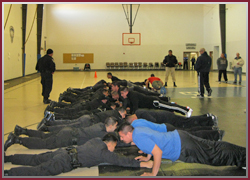
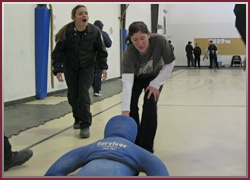
  • Due to high risk situations (ie. Injuries to officers/inmates, liability issues) that exists each time the S.R.T. is called out, it is required for all S.R.T. members to attend training classes.
  • A minimum of 8 hours per month of training is required for each member.
  •  
  • Training curriculum includes, but not limited to:
  • Defensive Tactics (ie. Handcuffing).
  • One man and multi-men cell extractions
  • Cell assaults
  • Tier clearing
  • Vehicle assaults ( Bus Evacuations)
  • Riot and Drill formations
  • Rescue / Hostage negotiations
  • Pepper-ball systems
  • Chemical munitions
  • Distraction Devices
  • Specialty impact munitions
  • Hall-way clearing
  • High Risk transport
  • Basic SRT school ( 40 hrs.)
  • Special Operations Group Corrections training ( SRT advance 40 hr. school)
  • Certifications courses
  •  
  • The role of the SRT during an emergency call-out
  • Any detention officer who feels that a situation would warrant calling out the S.R.T. will advise their immediate supervisor.
  • The ranking supervisor will notify the ranking S.R.T. commander and advise him/her on the type of emergency and any other pertinent information. The ranking S.R.T. commander will then activate the team to report to the S.R.T. room. The role and responsibility of each S.R.T. member.
  • Squad Leader - Responsible for all team activities including, but not limited to scheduling of practices, training, team member assignments, assessing the situation with the ranking S.R.T. commander, is the tactical commander in any squad deployment, observes the situation and make any necessary changes during deployment. Responsible for enforcing discipline and control of members. Conducts de-briefs and critiques.
  • Asst. Squad Leader - Must be well versed with the duties and responsibilities of the squad leader. May offer input to and will assist the squad leader in handling a disturbance or training need.
  • Squad Quartermaster - Main duties of the quarter- master is the proper care and storage of all equipment, perform necessary and appropriate maintenance on all equipment to include sending the equipment to service centers, assists in ordering new equipment, maintains the squad files which includes performance evaluations, fitness assessments or training records. The officer will issue equipment out during either call-outs or for training purposes. He/she will note any discrepancies or any unserviceable equipment to which he/she will advise the squad leader.
  • Team Member - The responsibility of each member is to adhere to departmental and divisional policy and procedures. Officer will also be responsible to know the duties in any tactical maneuver and emergency procedures. Each member will keep his S.R.T. equipment in their assigned wall locker at all times. The team member as well as other ranking members are expected to perform at a higher level of professionalism due to his/her high profile with the department.
  •  
  • Examples in which SRT may be called out
  • Violent or combative inmates.
  • Riot or disturbances.
  • Hostage situations.
  • Fires.
  • Bomb threats.
  • Any situation designated by the SHERIFF, Chief Deputy or Commander. (Can use S.R.T. as precautionary measure)
 
SWAT   El Paso County    El Paso County Sheriff's Officers Association   CALEA      Strike Team